
Searching Barbour County Criminal Dockets
Barbour County has no free name-search portal of its own. The official Barbour Circuit Clerk page points one-time searchers to Just One Look. The fee-based service is also known as Alacourt Access. It sells Alabama trial court case details one case at a time. For repeated read-only searching, Alacourt.com sells a paid subscription that may include images. AlaFile is a different tool entirely. It lets registered attorneys and self-represented filers submit and receive court papers. It is not a public criminal docket search.
Before paying anything, check the court. Figure out whether the case belongs to Barbour Circuit Court, District Court, or a municipal court. Write the case number exactly, keeping every prefix and leading zero. The portal may give no filed image or certified result. The Barbour County Circuit Clerk still holds the record.
- Read the citation, warrant, notice, or pleading and note the named court, Barbour County, and full case number.
- Use Just One Look for Barbour Circuit or District Court case details, or contact the municipal clerk when the issuing city owns the matter.
- Confirm the court, case type, filing date, status, and party caption before reading the event history.
- Read the newest settings and orders first because a later reset may replace an older court date.
- Ask the Circuit Clerk for the named paper, plain copy, or certified copy when the docket entry alone is not enough.
Barbour County Criminal Clerk Channels
Skip the fees and go straight to the source instead. The official Barbour court directory lists every division. Call the one that owns the record you need. Circuit Civil, Circuit Criminal, and divorce calls go to 334-687-1515. The Barbour County traffic desk answers at 334-687-1516. The Clayton clerk can be reached at 334-775-8366 or 334-775-8700. Walk-in requests work too. Go to One Court Square in Clayton or 405 East Barbour Street, Suite A119, in Eufaula, during posted clerk hours. Those counters also help with older files. That includes files that predate electronic imaging.
By mail, name the case number and case style. Also list the exact document, and whether you need a certified copy. Include contact and return-mail details, and call ahead about the amount, payment method, and postage. The clerk publishes no general records-request email, fax, drop box, or public terminal. Rule 33 still guarantees inspection and printed copies at the clerk office.
Note: The clerk says most records are imaged. A missing image does not mean the filing or case is gone.
Inside a Barbour County Criminal Docket
Think of a Barbour County criminal docket as an index, not a transcript. The header ties the case to a court and site. It also lists the judge, series, filing date, and current status. Below it, dated entries log events as they occur. Public charges, counsel, bond activity, motions, settings, rulings, disposition, and post-judgment work all appear there. The portal publishes no complete Barbour code menu. Confirm unfamiliar abbreviations with the clerk instead of guessing.
| Case identity | Full case number, filing date, Barbour court and site, criminal case type, judge, and status. |
|---|---|
| People and charge | State and defendant roles, public attorney data, offense, statute or class, and bond fields when public. |
| Event history | Complaint, warrant, indictment, plea, motions, notices, orders, continuances, and hearing entries in date order. |
| Setting | Date, time, and type such as arraignment, pretrial, motion hearing, plea, trial, sentencing, or review. |
| Outcome | Disposition date and result, sentence, fines, costs, restitution, appeal entries, and available document images. |
The Barbour County court record search covers the filed documents behind these event lines. It also explains the difference between a plain printout and clerk-certified paper.
Barbour County Criminal Docket Terms
Barbour County's own jury material defines two key charging terms. The docket adds several other plain legal labels. Together they help you tell the filing that starts a case apart from the event that ends it.
- Indictment
- A grand jury's written felony accusation. A felony may begin with preliminary work in District Court and later proceed in Circuit Court after indictment.
- Information
- A prosecutor's sworn written charge filed without grand-jury action, as defined in the local jury glossary.
- Nolle prosequi
- A prosecutor's decision not to continue the charge at that point. It is an outcome label, not a finding of guilt.
- Disposition
- The recorded result, such as guilty, acquitted, dismissed, or otherwise resolved.
- Bond forfeiture
- An entry tied to failure to meet bond or appearance duties. The current order and clerk should control its meaning.
An outcome line may show a guilty plea, trial verdict, sentence, appeal, or warrant. The county publishes no machine-code legend, so a terse docket line may call for the full order behind it before you can read it with confidence.
How a Criminal Case Moves
A criminal docket grows as the case moves. A complaint or warrant often creates the first public entries. An initial appearance then adds counsel and bond information. District Court handles misdemeanors and early felony proceedings. Later, the Circuit felony docket records indictment, arraignment, plea, pretrial motions, notices, and the trial or plea that resolves the charge.
Barbour criminal docket flow: Complaint or Warrant › Initial Appearance › Preliminary Proceeding › Indictment › Arraignment › Pretrial › Plea or Trial › Disposition › Sentencing.
After judgment, entries may cover an appeal notice, amended order, probation review, collection, or clearance event. Fines, costs, and restitution can appear on the docket, though a countywide report is no substitute for a person's own ledger. For scale, Barbour-Eufaula's FY2025 report lists criminal restitution disbursements of $42,536.60, and that figure is context only.
Barbour County Criminal Court Routing
A Barbour felony record can span two trial levels. District Court handles the early felony proceedings. The felony prosecution itself belongs to Circuit Court, the general-jurisdiction court. So an early setting may appear under District Court. Later activity shows up under Circuit Court. Misdemeanor and warrant work stays with District Court unless a city court owns the case. Eufaula Municipal Court, not the Circuit Clerk's state trial record, keeps Eufaula Police traffic and ordinance matters.
| Court | Criminal work | First contact |
|---|---|---|
| Barbour Circuit Court | Felonies after indictment, pleas, trials, sentences, and prescribed appeals | Circuit Criminal, 334-687-1515 |
| Barbour District Court | Misdemeanors, warrants, traffic outside city court, and felony preliminary matters | District clerk or courthouse counter |
| Municipal Court | City ordinance and municipal traffic cases | The issuing city's municipal clerk |
Note: The issuing court decides where the criminal docket is kept. A person's home address does not. The right clerk to confirm it follows from the court, not the map.
Courts That Hold Criminal Dockets
One clerk covers both trial courts here. The Barbour County Circuit Clerk keeps the dockets for Circuit Court and District Court alike. Other states split felony and misdemeanor filings between two elected offices. Probate and municipal records sit elsewhere. On the official Barbour Circuit Court page you can see the presiding judge's two locations. Judge or chambers staff can answer a scheduling question tied to one courtroom. The clerk, though, holds the criminal docket. That office also keeps the filed record itself.
Federal prosecutions never surface in Alacourt. Barbour County falls inside the U.S. District Court for the Middle District of Alabama. Its case files are searched through PACER. The official court image assigned here shows that separate federal trial layer for Barbour criminal docket work.
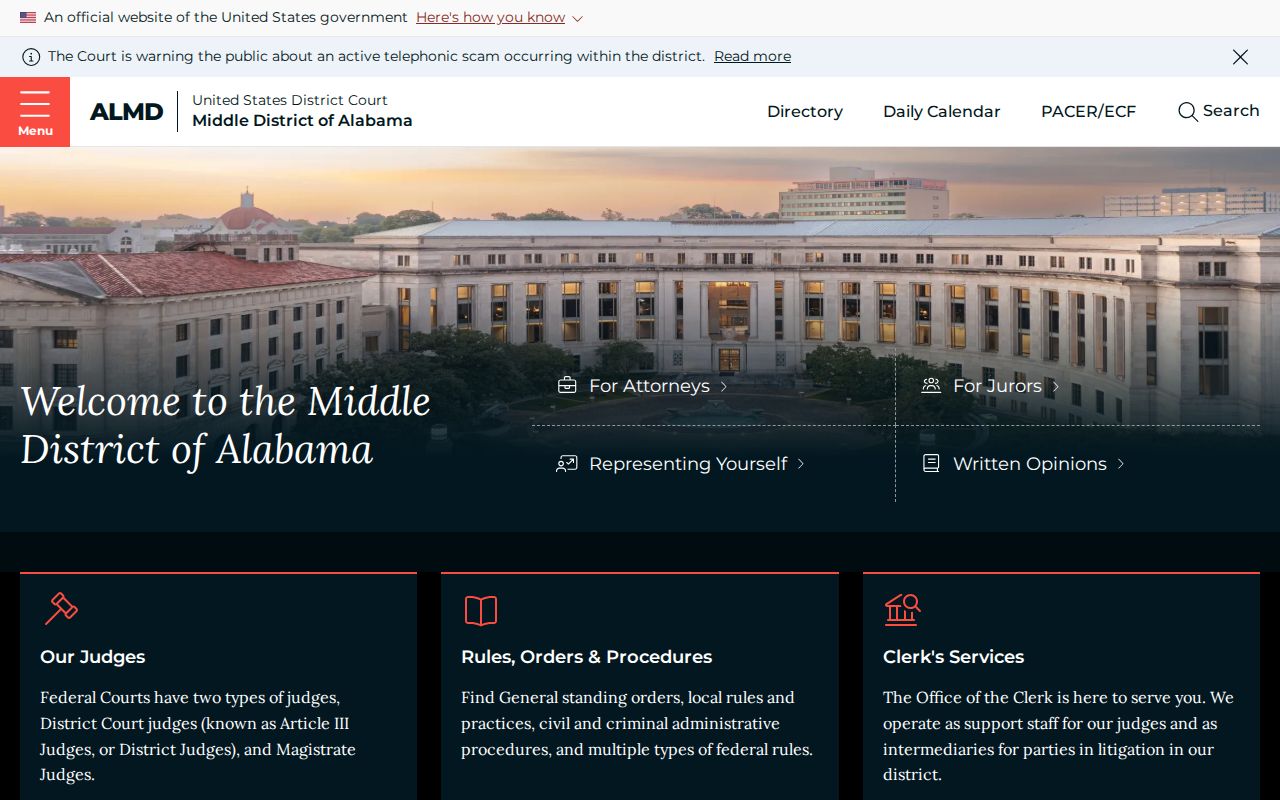
Do not mix this court up with Barbour Circuit Court. That court is an Alabama state trial court sitting in the 3rd Judicial Circuit.
Barbour County Criminal Appeals
A state criminal appeal climbs a ladder. It starts from the Barbour trial record, moves to the Alabama Court of Criminal Appeals, and in allowed cases reaches the Supreme Court of Alabama. The trial docket may show a notice of appeal. The appellate court builds its own case record after that. Alacourt holds neither federal trial files nor bankruptcy records.
For federal matters from Alabama, the appellate level belongs to the U.S. Court of Appeals for the Eleventh Circuit, shown in the official court image.
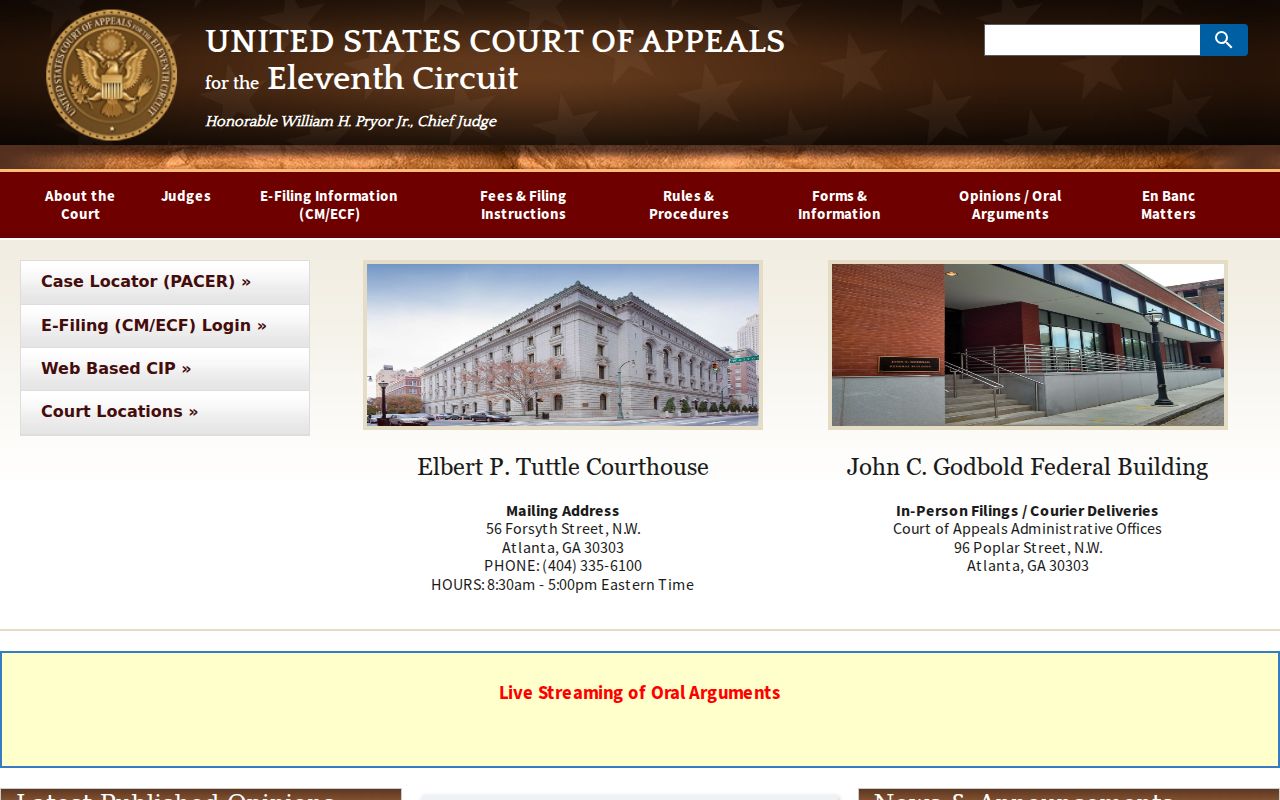
Need a federal trial docket? Start with the Middle District and PACER, not the state Just One Look service. The U.S. Bankruptcy Court for the Middle District of Alabama keeps its own separate federal records, shown in the assigned court image.
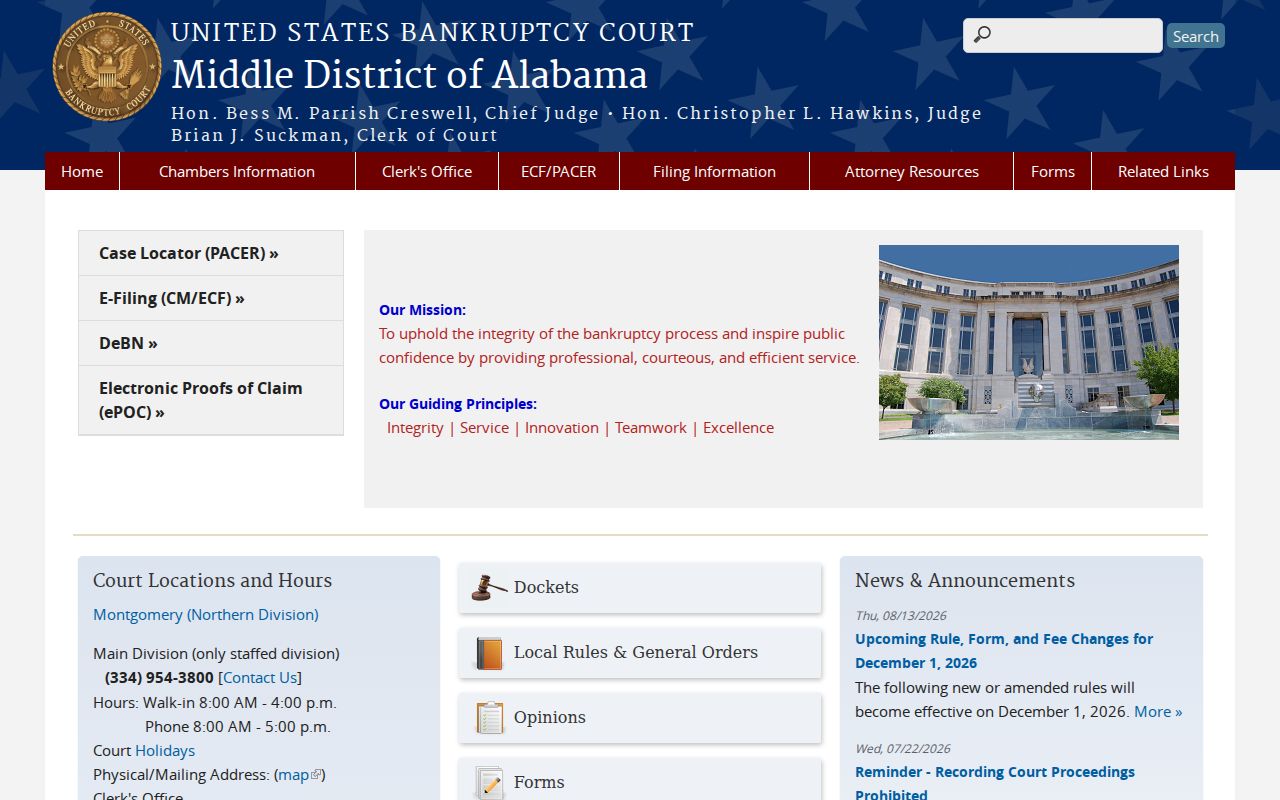
Bankruptcy is not part of a Barbour County criminal docket. A party name can resemble a state case name and still be a different matter entirely.
Sealed Dockets and Public Access
Much of the ordinary Barbour County criminal docket can be inspected at the clerk office. A great deal of it is imaged electronically. Still, public access stops short of everything. Juvenile cases are generally restricted. Sealed entries or documents can drop out of public view. Protected identifiers get redacted before release. An online gap can also stem from searching the wrong court. It may come from omitting a prefix, entry delay, or an older file. So an absence proves nothing about whether a case ever existed or was expunged.
Alabama access rules:
Rule 33(D), Alabama Rules of Judicial Administration preserves public inspection, viewing, and paid printed copies at circuit-clerk offices.
Alabama Rules of Court-Record Privacy and Confidentiality govern protected data, redaction, sealing, and public versions.
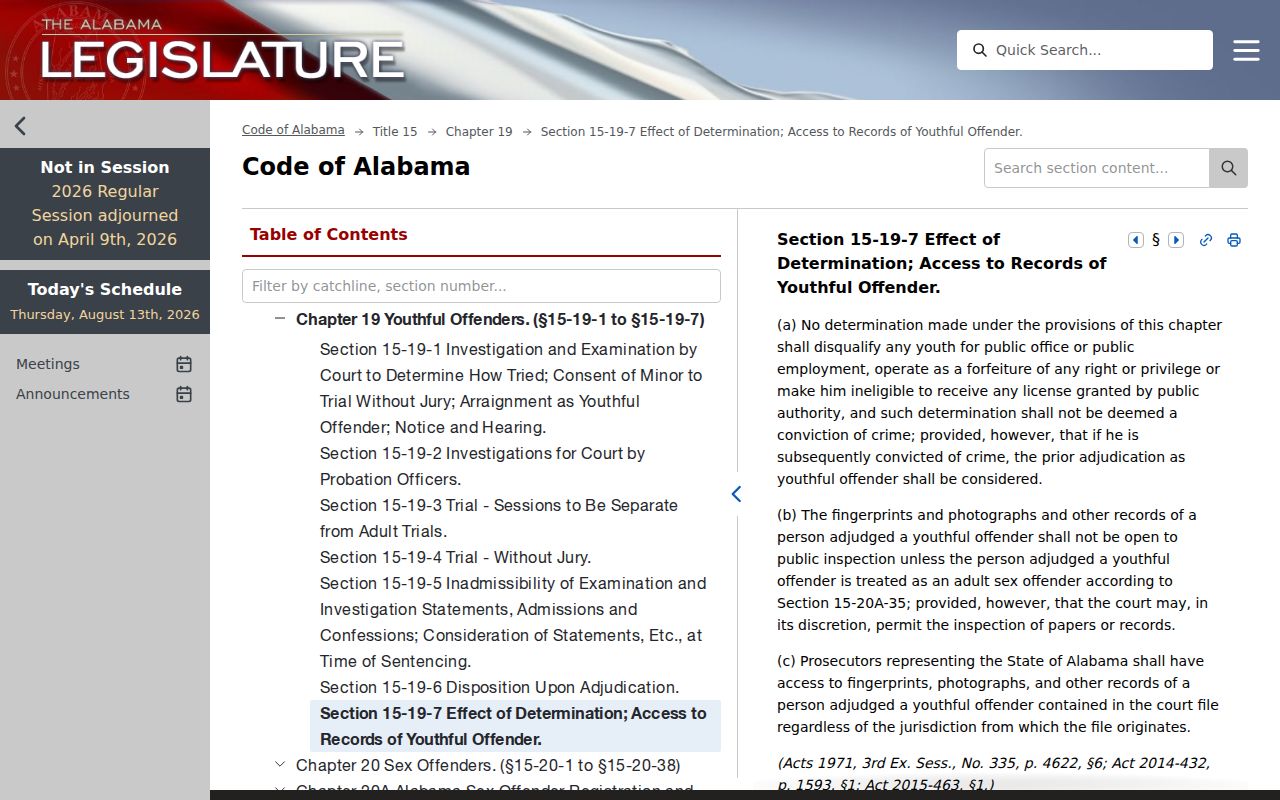
Ala. Code §15-19-7 restricts public inspection of youthful-offender photographs, fingerprints, and other records.
The official youthful-offender law is also represented by its assigned source image.
If you are entitled to restricted material, use the court's authorized process to get it. Working around a restriction through alternate public searches is not the way.
Barbour County Criminal Setting Checks
Confirm a criminal setting in order. Newest notice comes first, then the latest docket event. Then try the division clerk. Chambers comes last for a court-specific check. A reset or continuance can push an earlier date aside. Filing a motion does not cancel your duty to appear. The judge still has to grant it. Barbour publishes no verified standalone daily criminal calendar. So treat a portal history as history, not a live courtroom board.
When a search result vanishes, test the court first. Then check the case prefix and your access category before concluding anything. A youthful-offender or sealed matter may be hidden by law. An old record may simply lack an image. For an ordinary public case with a doubtful date, call the criminal desk. That number is 334-687-1515, the direct Barbour County confirmation channel. A full name-based workflow is available through the Barbour County case lookup.